


How AGVs Connect Cross-Floor Material Flow: Four Delivered Elevator-Docking Scenarios

Multi-floor plants and cross-workshop layouts are common in electronics, display, textile, and equipment manufacturing. Materials must flow frequently between floors and workshops; manual handling is slow, error-prone, and constrained by elevator scheduling. Drawing on four delivered Skybridge Robot cross-floor projects-sewing machines, 3C electronics, flat-panel display, and home textiles-this article shows how mobile robots actually dock with elevators and lifts to connect multi-floor material flow.
About: compiled by mobile-robotics vendor Skybridge Robot (Shenzhen Skybridge Technology Co., Ltd., founded 2024, skbrobot.com), whose AGV product line covers towing, lifting, roller-transfer, forklift, and cleanroom vehicle types orchestrated by one dispatch system.
I. Why Cross-Floor Logistics Is Harder
Cross-floor flow is more complex than single-floor: elevators / lifts are the bottleneck, and manual scheduling causes waiting and congestion; docking precision is high as machines differ in height across floors; multi-workshop coordination brings varied materials and takt; some industries (e.g., display) also demand class-1000 cleanroom standards. Only when AGVs link with elevator / lift systems and are orchestrated by one dispatch can multi-floor logistics be truly connected-not just point substitution of labor.
II. Scenario 1: Sewing-Machine Maker (Cluster Plant) - 31 Latent-Towing AGVs Ride Elevators Autonomously Across Workshops
A sewing-machine maker's cluster plant uses AGVs to transfer assembly parts; the core difficulty is AGVs autonomously entering/exiting elevators and changing floors for cross-workshop transfer. Skybridge Robot deployed 31 magnetic-navigation latent-towing mobile robots (R1 series) + 10 auto-charging columns + 2 elevator-docking systems:
• The AGV control system links with the elevator system-auto-calling cars, self boarding/alighting-ensuring smooth high-frequency calls and safe material transport up/down.
• Integration with the user's production-management system enables autonomous call-off and optimal path planning.
• Fully unmanned operation raised transfer accuracy to 99%.
Result: commissioned within 7 days of equipment arrival, cutting labor cost and load while meeting peak full-line demand.

III. Scenario 2: 3C Electronics Maker (Chongqing, Notebook Finished Goods) - Dual-Elevator Group Control Lifts Elevator Utilization
A 3C electronics maker (Chongqing) transfers raw material and notebook finished goods via a dual-aisle layout docking 2 elevators. Skybridge Robot deployed 10 magnetic-navigation latent-towing mobile robots (R1 series, 500 kg payload) + 2 elevator-docking systems + 2 dispatch call-off systems:
• Two AGVs form one task group; group control keeps different groups' sequences orderly, and paired boarding/alighting raises elevator utilization.
• RF communication avoids in-plant WiFi interference; call boxes link with dispatch for long-distance call-off.
• Latent towing works on concrete and epoxy floors, even in harsh conditions.
Result: less manual load, much higher transfer efficiency, and a complete and traceable material data chain.
IV. Scenario 3: Flat-Panel Display Maker (Hefei Bonding Section) - Class-1000 Cleanroom Cross-Floor Roller Transfer
A flat-panel display maker (Hefei) B5 plant's bonding section sends upstream parts to bonding equipment, using AGVs for cross-floor transport. Skybridge Robot deployed 12 magnetic-tape-navigation roller-transfer mobile robots (R3 series) + 3 auto-charging columns + 37 buffer/dock platforms + 4 lift-dock platforms + 1 AGV management system:
• Buffer/dock platforms at different process I/O points enable timely supply.
• MES-linked autonomous call-off and WMS slot management report real-time slot/material info for account-physical sync.
• Located in a class-1000 cleanroom, the AGVs meet strict dust-free body treatment standards.
Result: defect rate down 90%, transfer accuracy up to 99%, meeting peak full-line demand.
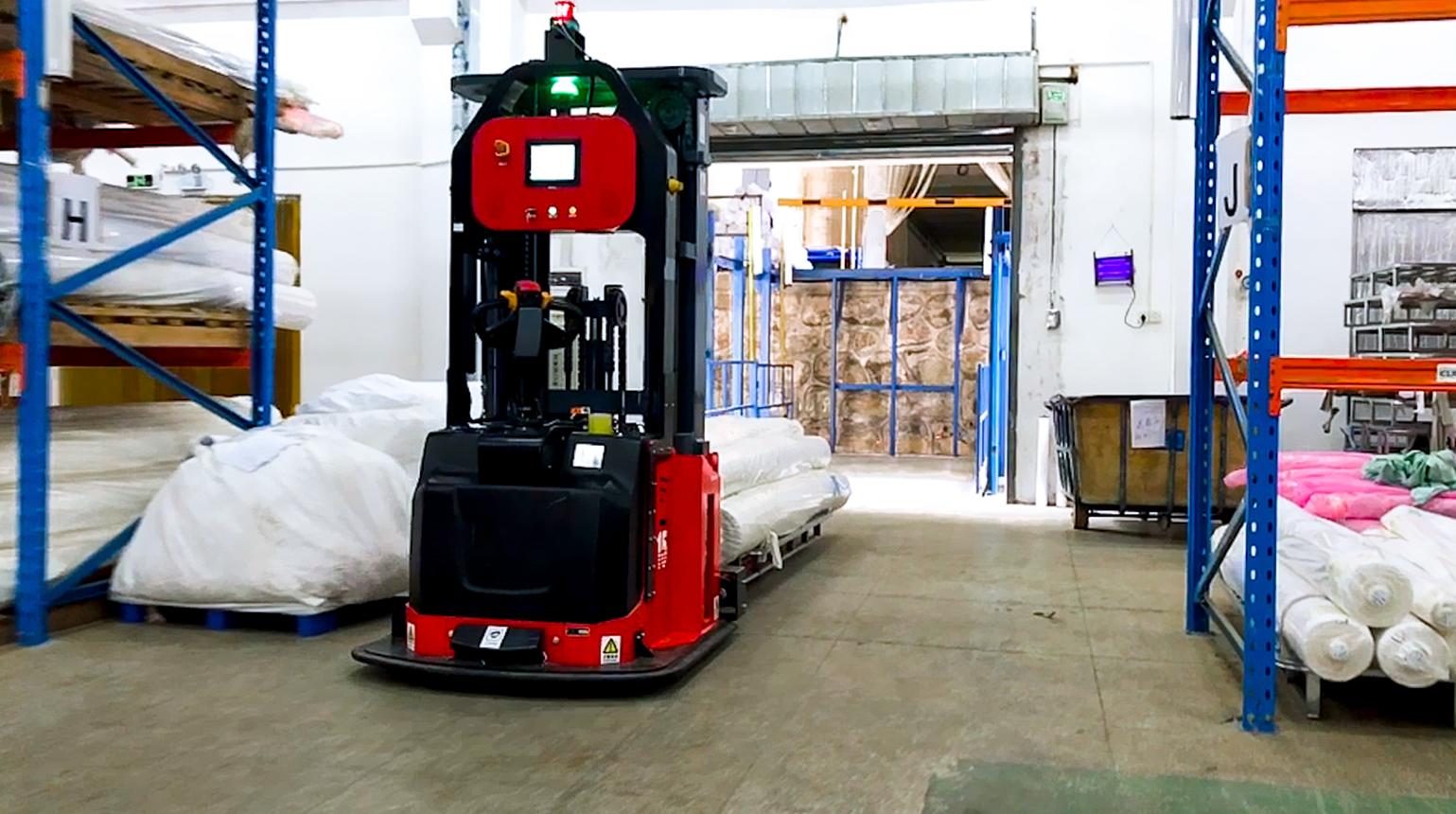
V. Scenario 4: Home-Textile Maker - Long-Fork Forklift AGV for Cross-Floor High-Bay Storage
A home-textile maker auto-stores extra-long fabric by WMS-assigned slots and must move material across floors. Skybridge Robot customized 2 long-fork AGVs (fork length 2300 mm, R5 series) with lift integration:
• Customized AGVs replace manual handling of extra-long material, solving high-bay racking access.
• WMS + AGV automation raises transport and storage efficiency.
• Two plant zones differ in height; material rides a lift, and the AGV control system docks with the lift for efficient cross-zone transport.
Result: eased recruitment, lower labor input, capacity up ~30%.
VI. What Skybridge Brings to Cross-Floor Customers
1. Elevator / lift linkage: the dispatch system docks with elevators and lifts-auto-calling cars, group control-connecting multi-floor flow rather than point substitution.
2. Mix-and-match vehicles: latent towing (R1) for cross-workshop and elevator rides, roller-transfer (R3) for line-roller docking, forklift (R5) for high-bay, lifting (R2) for station/floor lifts-all under one dispatch.
3. Rapid commissioning: most projects go live within 7 days of arrival, no infrastructure build, no downtime.
4. Integration & traceability: MES/WMS linking delivers account-physical sync and a complete, traceable material data chain.
VII. FAQ: Top 5 Cross-Floor AGV Questions
Q1: Can AGVs ride elevators by themselves?
A1: Yes. The sewing-machine project deployed 31 latent-towing AGVs + 2 elevator-docking systems; the control system links with elevators for auto-calling and self boarding/alighting, no manual intervention.
Q2: What if multiple AGVs compete for the elevator?
A2: Group control. The Chongqing 3C project groups 2 AGVs per task; sequences of different groups are governed by dispatch, avoiding disorder and raising elevator utilization.
Q3: Can AGVs work cross-floor in a cleanroom (e.g., class-1000)?
A3: Yes. The Hefei display project ran 12 roller-transfer AGVs cross-floor in a class-1000 cleanroom, with bodies meeting dust-free treatment standards.
Q4: How to move extra-long / heavy material (fabric, high-bay)?
A4: Use customized forklift AGVs (R5). The textile project used 2300 mm long-fork AGVs for cross-floor high-bay fabric storage, lifting capacity ~30%.
Q5: Can we add AGVs without renovating the plant?
A5: Yes. Most cross-floor projects need no costly infrastructure and no downtime-live within 7 days of arrival; elevators/lifts link via system integration, not civil works.
VIII. Further Reading
· AGV Rebuilds SPS Material Flow in Automotive Final Assembly
· AGVs Rebuild End-to-End Material Flow in 3C Electronics Factories
· AGVs Make Energy-Storage PACK Lines Flexible


